
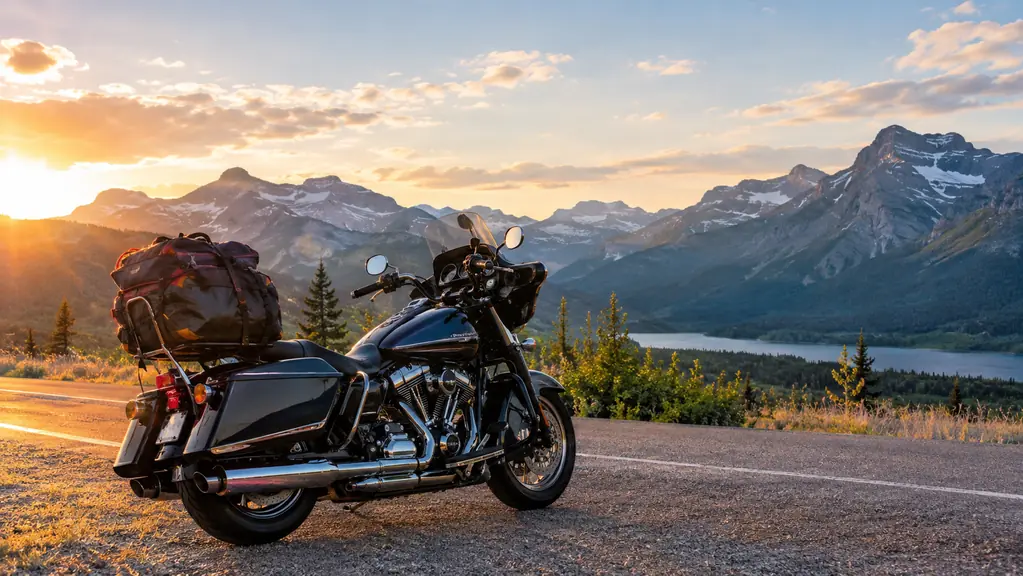
Every July I point my Road King east out of Twin Falls and just go. This past summer the plan was a ten-day loop through Montana, Wyoming, and back down through Utah, about 2,100 miles total, with Carol on the back for the first leg. The problem before I left was the same one I have every year: where to put everything. Hard bags on a touring bike hold a lot, but they do not hold a spare helmet, a second pair of boots, or the rain gear you hope you will not need. I have burned more trip days strapping a duffel to the seat and watching it sag into the exhaust than I care to count. So this year I tried a Rhinowalk tail bag, the expandable 33 to 45 liter model with the sissy bar straps, and I ran it hard for the whole trip.
This is not a review after one weekend ride. It is a review after ten days, 2,100 miles, one genuine Montana downpour, a stretch of Wyoming wind that tried to peel the paint off the tank, and about 400 miles of gravel and chip seal that I did not plan for. The bag cost me some setup time on day one, and after that I mostly forgot it was there. That is the highest compliment I can pay any luggage.
The Quick Verdict
A tough, genuinely expandable tail bag that took a 2,100-mile multi-state trip, one hard rain, and a lot of wind without coming loose or leaking. Not perfect, but it is the soft luggage I would buy again.
Amazon Check Today's Price →A tail bag that survived 2,100 miles in ten days
The Rhinowalk expandable tail bag carried a full camp load, a spare helmet, and a week of rain gear without a loose strap. Check today's price on Amazon and see if it fits your bike.
Amazon Check Today's Price on Amazon →How I've Used It
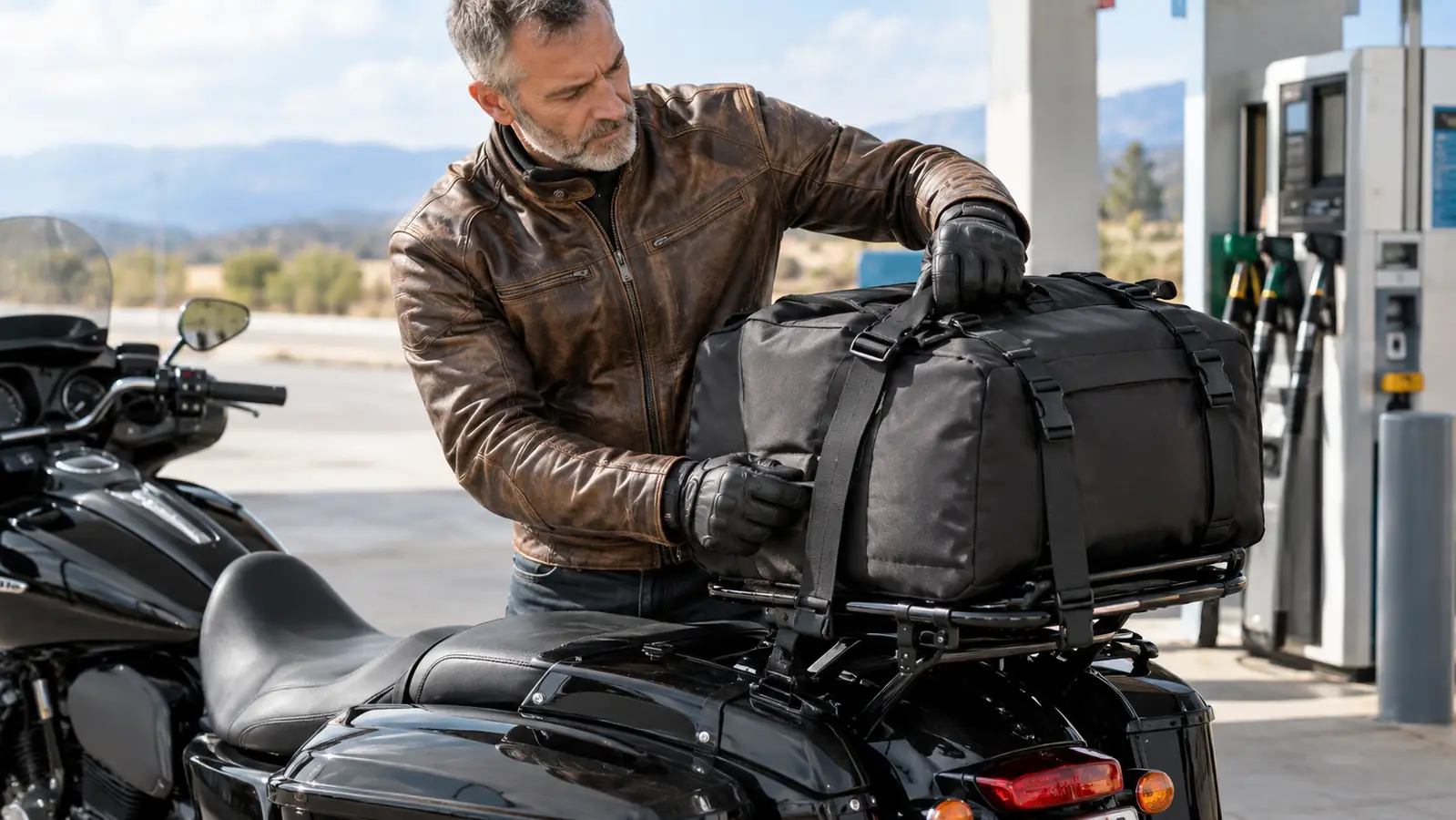
The bag mounts with four straps that wrap around the sissy bar and the luggage rack. Day one I spent maybe twenty minutes getting the strap lengths set, and after that I did not touch them for the whole trip. The straps use plastic cam buckles that lock down hard, and I learned early to tuck the loose ends under the bag so they did not flap in the wind. Once I did that, nothing moved.
In the expanded 45 liter mode I packed two full sets of riding gear, a week's worth of casual clothes, a small tool roll, a tire plug kit, and a thin rain shell. That is more than I have ever gotten into a soft duffel on the rack. The bag is structured enough to keep its shape when full, so it did not sag into the rear fender or the exhaust. The included helmet rain cover is thin, but it worked. I used it to wrap a spare helmet that I strapped on top of the bag for the first leg, and the helmet stayed dry through the same rain that soaked the road.
On the road I stopped worrying about it by day two. The bag sits high enough that I can reach it without getting off the bike, which mattered when I wanted a layer out at a gas stop. It did not block the brake light, and it did not get in the way of Carol's grab handles or her back rest. The main zipper is heavy duty and never once popped open, even when I overstuffed the compartment on the way home.
What the Expandable Design Actually Does
The expandable part is not a gimmick. There is a zipper around the middle of the bag that, when unzipped, adds roughly twelve liters of height. In the collapsed 33 liter mode the bag sits low and keeps the bike looking tidy around town. On trip mornings I unzipped it, packed it full, and zipped it back down to compress the load so nothing rattled. That zipper is heavy duty, and it never bound up, even with a full load pushing against it.
The bag has a stiff base and padded walls, so it holds its shape whether it is half full or stuffed. That is the difference between this and the cheap roll top bags I have owned. A floppy bag shifts as you ride, and a shifting load on a tall bike is noticeable in corners, especially on canyon roads where the pavement changes mid turn. This one sat still.
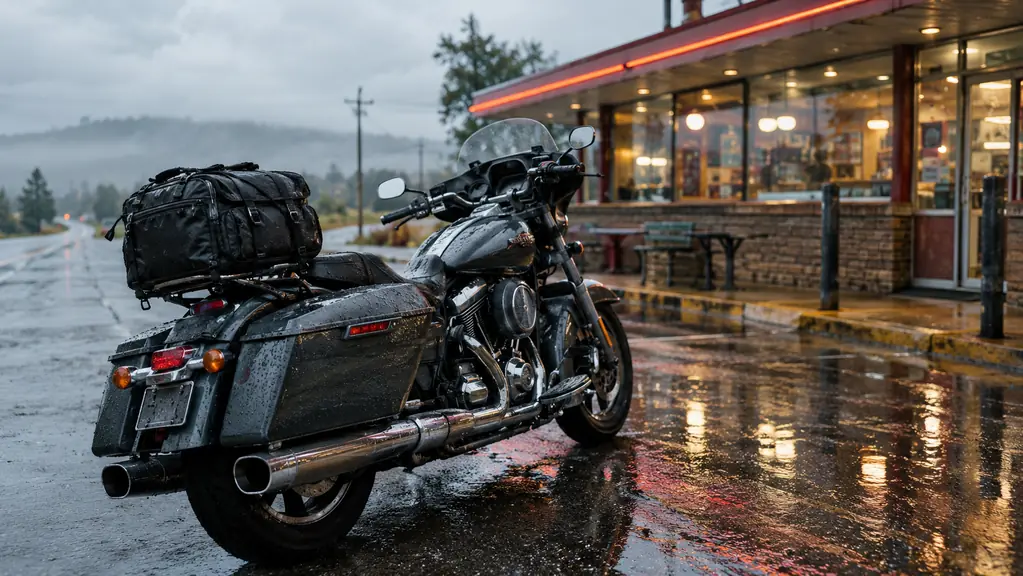
Rhinowalk calls the material all-weather, and the seams are taped. I would call the bag itself highly water resistant, and genuinely watertight when you use the included cover. We hit one hard Montana downpour that lasted forty five minutes. The bag was soaked on the outside, and everything inside stayed dry, including the paperback Carol was reading at the motel that night. I have not tested it submerged in a creek, and I am not planning to.
The 33 liter collapsed mode is what I used most around town. With the bag zipped down, it holds a laptop, a change of clothes, and a set of rain pants, which covers about ninety percent of my daily rides. On those short trips the bag is low enough that it does not block the mirrors or make the bike feel top heavy. It only becomes a different piece of luggage when you unzip it for a trip.
How It Held Up Over the Miles
By the end of the trip the bag had covered 2,100 miles, roughly 1,700 of them on pavement and the rest on gravel and chip seal. The base shows light scuffing from vibration against the rack, but there are no tears, no broken zipper teeth, and no loose stitching. The straps look as good as they did on day one. I expected at least one buckle to give up by the end of the trip. None did.
The Wyoming stretch is where luggage goes to die. Crosswinds ran steady at twenty five miles an hour with higher gusts, and at highway speed the expanded bag acted like a small sail. I felt it in the handlebars, but it never shifted on the rack. The cam buckles held. That same stretch taught me to check strap tension at fuel stops, because after a full day of vibration a strap can loosen just enough to notice. Two minutes with the buckles and it was good for another four hundred miles.
Idaho and Utah in July mean heat. The bag sat in direct sun for hours at a time, and the material never softened, warped, or faded. The zippers stayed smooth when they were hot to the touch. I also left the bag on the bike overnight twice, and the morning dew beaded up on the surface and wiped off with a glove. For a piece of soft luggage at this price point, that level of durability surprised me.
The only maintenance I did all trip was wiping the bag down at a car wash and checking the four strap buckles for grit. One buckle picked up a little sand on the gravel stretch and I blew it out with compressed air at a gas station. That was it. For comparison, my old canvas duffel needed new buckles after one season, and a hard case latch on a friend's bike broke on the same kind of gravel. This bag asked for less than either.
After 2,100 miles, one Montana downpour, and a day of Wyoming wind that tried to take everything off the rack, the Rhinowalk bag never came loose and nothing inside got wet.
Where It Falls Short
It is not a perfect bag, and I would not pretend otherwise. In the expanded mode it rides tall, and a tall soft bag catches wind. On my Road King it was manageable, but on a lighter bike with less weight over the front wheel I would be more careful in a strong crosswind. If you ride a naked bike or a smaller standard, the expanded mode will change how the bike feels at speed, and you should test that before a long trip.
The straps are long enough for most sissy bars, but this is not a quick release system. If you want to take the bag off at every motel, you will spend a minute or two working four buckles. I left mine on the bike most nights and carried the valuables inside. And if your bike has no sissy bar and no luggage rack, this bag will not work for you at all. It needs something to wrap around, full stop.
The included rain cover is thin, and the elastic edge is snug but not generous. I had to tuck the corners under the straps to keep it from flapping in the wind. It did its job in the downpour, but I would not trust it in hours of steady heavy rain. The bag itself is water resistant, not a dry suit, and deep water crossings are a hard no. Know that going in and you will not be disappointed.
There is also the question of how the bag looks on the bike. I do not care much about that, but some riders do. A soft tail bag is never going to look as clean as a matched set of hard cases, and the expanded mode looks like a duffel strapped to a rack, because that is basically what it is. If looks matter more to you than function, buy the hard cases and pay the weight penalty.
Alternatives I Considered
I have ridden with hard saddlebags and a top case for years, and they are great until they are not. Hard cases lock, which is nice, but they are heavy, they rattle, and they cost more than most riders want to spend on luggage. For a trip like mine the Rhinowalk bag did the same job at a fraction of the weight, and I could carry it into a motel room in one hand if I wanted to.
I have also owned the cheap canvas duffels and the roll top dry bags that everyone tries first. The canvas duffel sagged, the buckles rusted, and the roll top dry bag was waterproof but miserable to pack because it is just a tube. The Rhinowalk bag sits in the middle: structured like a case, light like a duffel, and dry when it needs to be. If you are weighing it against hard luggage, the side by side comparison on this site goes deeper into that tradeoff.
What I'd Pack Differently Next Time
If I were doing the trip again, I would pack lighter in the expanded mode and use the compression zipper more aggressively. The bag holds 45 liters, but a full 45 liters of loose clothes is a lot of weight sitting high over the rear wheel. On the way out I packed heavy and the bike felt it in the slow canyon corners. On the way home I packed the same stuff tighter, used the compression, and the difference was real.
I would also bring a small dry bag for the wet stuff instead of trusting the cover on a day of stop-and-start rain. The cover worked in the downpour, but on a day when the rain came and went, taking the cover on and off at every stop got old. A small dry bag inside the main compartment would have let me leave the cover on the whole time. That is a small change, but it is the kind of thing you only learn after a week on the road.
What I Liked
- Expandable 33 to 45 liters gives real room when you need it and a tidy profile when you do not
- Held up over 2,100 miles with no torn stitching, no broken zippers, and no failed buckles
- Stiff base and padded walls keep the load from shifting in corners
- Kept everything dry through a forty five minute downpour with the included cover
- Light enough to carry into a motel room in one hand
Where It Falls Short
- Catches wind when fully expanded, noticeable on lighter bikes
- Needs a sissy bar or luggage rack to mount to, no option for a bare fender
- Not lockable, a zipper keeps honest people out and nothing more
- Rain cover is thin and needs tucking under the straps to stay put
Who This Is For
This bag is for the rider who does one or two long trips a year and wants soft luggage that behaves like hard luggage. It is for the rider who needs more room than saddlebags offer, who wants to carry a helmet or a week of clothes, and who does not want to spend touring case money to do it. It is also for the rider whose bike has a sissy bar or a luggage rack and who wants something that comes off in two minutes and goes into a motel room. If that sounds like you, this is a strong buy.
Who Should Skip It
Skip it if your bike has no sissy bar and no rack, because the straps need something to wrap around. Skip it if you need lockable storage, because a zipper is not a lock and soft luggage is a target. Skip it if you ride a lightweight bike and plan to run it fully expanded, because the tall load will catch wind and you will feel it. And if you expect to ride through hours of steady rain without stopping to fit the cover, get a proper roll top dry bag instead. This is a great tail bag. It is just not a dry suit.
Ready for a trip without the duffel sag?
The Rhinowalk expandable tail bag did 2,100 miles across four states without coming loose or leaking. See what it costs on Amazon today and check the fit for your bike.
Amazon Check Today's Price on Amazon →